Dutch black metal band Doodswens went through a lot in a few years: inception, gaining momentum, releasing a first album, Lichtvrees, on Svart Records, touring, and eventually, massive changes in the line-up. Fraukje van Burg interviewed here left the band, but Doodswens lives on: I. is still on drums, and S. on guitar and N. on vocals and bass joined forces. I haven’t changed a word of the following interview; it is a candid snapshot of an emerging artist that is just as sincere and compelling as it was when I first wrote it.
–
In more ways than one, the first demo of Doodswens is a blaze in the Northern—well, Dutch—sky. Icy and incandescent, the music from Fraukje van Burg (vocals, guitar) and Inge van der Zon (drums) isn’t straight up Scandinavian second wave of black metal worship, but it channels its energy, raw, fiery, and visceral. These first songs scored them a spot at the iconic Roadburn Festival and hold a lot of promises. We chatted with Fraukje about the past, present, and future of the band.
This interview took place the 29th of November 2020 and was first published in Stryga, a fanzine published by the enchanting Lia of Absaintes. It’s a stunning thing and you should definitely buy it here.
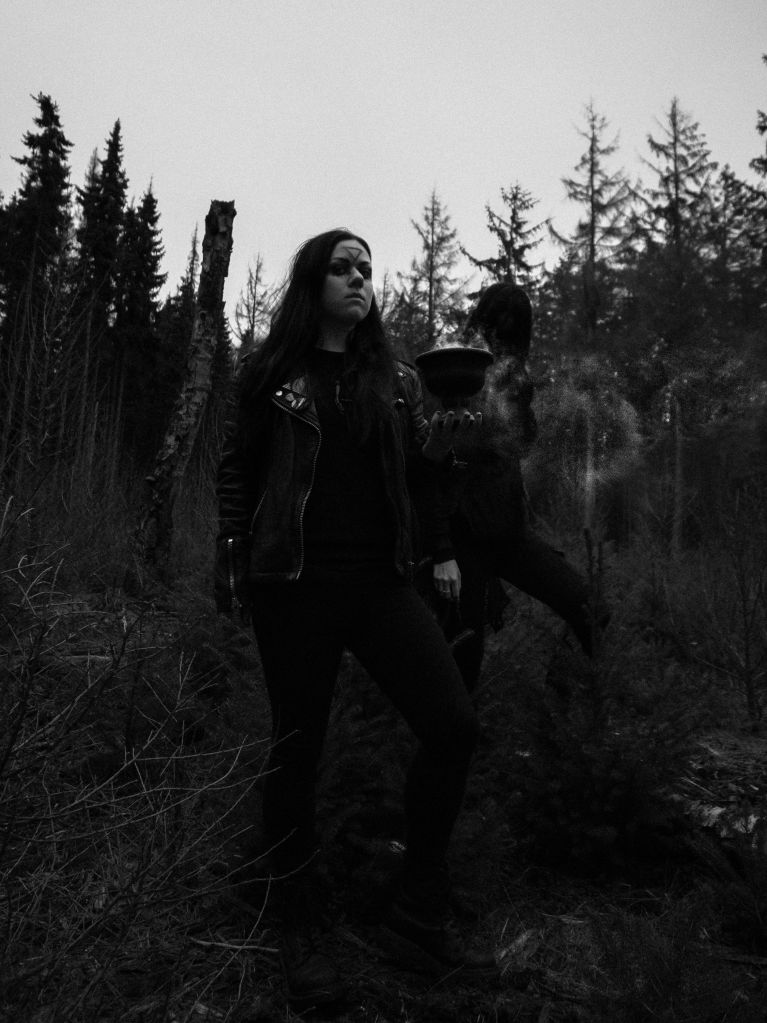
How did you and Inge form the band?
We both went to the same music college in Eindhoven. Everyone in our class loved heavier music but not necessarily black metal, so when I saw Inge sitting there in a Mayhem T-shirt and patches from black metal bands on the introduction day, I knew I had to talk to her. I introduced myself, she told me that she’s a drummer, and I said, “Oh, I’m a guitarist and I do vocals too, wanna jam sometime?” We went to a rehearsal space and it all went from there. It was always my dream, I think, to form a black metal band. It’s my favorite genre and it’s very close to my heart, but I had never found the right people to do it before. It wasn’t really a goal, but a wish. At the very beginning, we thought about adding a bass player, but soon the idea faded. It feels great to be just the two of us. Why should we add someone else that may have another mindset? We don’t want the drama of more people in the band. Doodswens is Inge and me, it’ll never change.
When did you discover black metal?
I think I was around twelve, thirteen years-old. I was already into rock’n’roll music, progressive rock. My parents’ favorite band is Pink Floyd, that’s what I grew up with. There was this guy at my school with long hair and T-shirts of bands I didn’t know. He intrigued me, so we started talking and he showed me all these black metal bands, told me the story of Mayhem… I was flabbergasted! The extremeness of it all spoke to me. My favorite black metal band is Darkthrone, obviously. I love the whole thing, the corpse paint, the icy riffs, the dark and mean cloud that hang above it all. I just love that atmosphere. When we started out, though, we didn’t think, “We’re going to wear corpse paint and copy the bands of the second wave.” It all went smoothly, we just did our own thing and eventually, it turned out to be like this. We didn’t make any rules or thought about it too much, everything happened; if it felt right, we did it. Before the first show, Inge and I were wondering what we were going to wear on stage, if we would wear corpse paint, and she said, “Let’s see how we feel an hour before the show, and if we don’t feel like it, we won’t do it, if we do, we will.” We just do what feels best.
But as much as I love Darkthrone, I’m also into more modern, atmospheric black metal bands, especially the Dutch scene: Laster, Grey Aura… Over the last ten years, there’s been a huge new wave of black metal bands who have a more modern and artistic take on black metal in the Netherlands, and I really love that. They combine poetry and art with music; Grey Aura, for instance, takes elements from shoegaze, post-rock, and uses it in black metal. There is a lot of traditional bands here which I also really like, and a lot of traditional black metal fans as well, who don’t like that modern, “poser” stuff, that “hipster black metal”, but I don’t care what they call it, I really like both and I draw inspiration from both. These days, I’m leaning more towards the modern take on black metal. It’s not necessarily new, but it has something, it’s looking out of the box, further than Satan and all these cliché ideas of what black metal should be. They don’t give a fuck about what people think, this is something I really respect. Music is changing all the time, black metal can’t stay traditional and “trve” forever, it has to change to move forward.
These Dutch bands are the reason why the band has a Dutch name, Doodswens [Deathwish], and the new full-length album we’re working on will have all the lyrics written in Dutch. To me, black metal is more than music. It’s a whole thought process, it’s a lifestyle, it’s a mindset, and it doesn’t just inspire me in music, but also in life. The viewpoints of all these artists combined create new perspectives on life, it inspires me in all ways possible.
Could you talk about a couple of records of this scene that are dear to you?
Sure! The first one would be the second album by Wiegedood, the Belgian band: De doden hebben het goed II. It’s part of the “De doden hebben het goed [The dead have it good]” trilogy. It’s a modern band with traditional elements. Every song is very long, each album has just four and all the songs tell a different story. It’s a big experience to listen to them, you can just listen to it in the dark with a few candles burning, it doesn’t get boring. The second one isn’t black metal: it’s Summerland by Dool, an amazing band from Rotterdam. The frontwoman, Ryanne van Dorst, is amazing. She’s this fucking cool power woman who inspired me to play on a Fender Jazzmaster; she’s the reason why I own one. It isn’t black metal but it has a dark, occult, mysterious vibe, a bit like The Devil’s Blood. And a third one would be De verste verte is hier by Laster. The sound is almost inaudible, you can’t really tell what is guitar and what is vocals. They sound like they’re playing in a church and the microphone is set 30 feet away from them, like it’s just reverb and atmosphere. That’s what makes it so cool. It’s the sound I want on the new Doodswens album. Wessel [Reijman], the drummer from Laster, is the one who’s going to record and produce us—he works at the Catacomben studios in Utrecht. We really love his sound, it’s a bit modern but not too modern. It’s not as noisy, foggy, and inaudible as our demo, but it has this really atmospheric type of vibe that we really dig. It’s going to be… not clean, but cleaner, a step higher.

What else can you say about this new album?
It should have been done by now, we should have premiered it at Roadburn 2020. But that didn’t happen because of the coronavirus, so the recording process got delayed and it all went off the rails. With the pandemic, we got a lot more time to think about it and to change things, write new material, and really ask ourselves, “Is it really what we’re going to release?” Eventually, we changed the whole thing! This period of rest gave us the opportunity to look more into it and take it to the next level. It’s been in one way a positive thing for us. Now, we’re going to record it, and hopefully, we can release it at Roadburn 2021…
It’s going to be called “Lichtvrees”, which means “Fear of light”. It’s going to be a concept album with two sides, one for me and one for Inge. The songs will tell stories from both of our lives, the demons we faced in the past two years. We came out stronger out of these situations and we both have another perspective on life, now. Eventually, the circle is whole again, everything in life makes sense, everything happens for a reason. That’s the main idea. Death is an essential part of both of our storylines. Two essential people in our lives passed away in the last two years and we want to pay a tribute to them with a couple of songs. Both Inge and I went through a very dark period where we thought, “Is death the solution for everything?” We came to the conclusion that maybe it is, maybe it isn’t—what is the meaning of life, the meaning of death, you’ll never know until you experience it yourself. It’s our whole philosophy of life and death and everything that has to do with it. Death is a big inspiration to us. The mystery that revolves around it, its emotional dimension…
I have these dark days in my life, dark periods during which I can’t write, I can’t get myself to pick up to my guitar and be productive. In my good moments, I think back on those negative times and then I have the motivation to pick up my guitar. Then, I’m extremely productive. Our music is about misery and death and a lot of negative stuff, but I can turn it all into something good by writing about it, making art about it… It helps me cope. It sounds very cliché, but if I didn’t have music, I don’t know if I could deal with all my feelings being caught up inside. I need the creativity in my life to function. I have a 9-to-5 day job, and it’s a great one, but it’s not something that makes my life worth living and that gives me fulfillment. It’s the music that does that. The gigs give me energy. At the end of a show, when you’re done with your set, it’s the most euphoric feeling ever.
You’re also a photographer, you’re in charge of the visuals of the band. Do you see the artwork and the music as a whole?
For me, art and music go hand in hand. I like to stay in charge of most of the visuals in Doodswens—not all of them, sometimes, we do commission other artists. Our first single on the From the Shadows of the Abyss split, “In de Schaduwen der Levenden”, has an amazing painting we asked a friend to do. I can’t paint like that! But I did some photos for the T-shirts, for the posters… My biggest inspiration for my photography would be Nona Limmen, a Dutch photographer from Amsterdam who did photos for Chelsea Wolfe, for Dool… Her photos have the eerie, mysterious vibe that I also want to recreate. Visuals are very important for a band; it’s the first thing people see and form an opinion on, without good visuals, you can’t exactly express the message in the best way.
You started playing live very early on. Was it your main goal?
As with almost pretty much everything at the beginning, the first live gig just happened. After two months of practice, we told a friend, Niels [‘t Hoen], who organizes the Black Rituals gigs at the Little Devil in Tilburg, about our band, even though we didn’t have a name or a setlist yet. He immediately asked us if we wanted to open for Oraculum from Chile, and we were like, “Yeah, fuck it, let’s go! We have about a month, that might be doable!” We picked a band name and wrote a few songs in a rush to finish the setlist. We thought no one would come, it was just a tiny local show, but it was almost sold-out. We were like, “Oh fuck, this isn’t what we signed up for!” but we just did it and it felt right. We thought we’d be up for ten shows a year, something like that.
Then one day, Walter Hoeijmakers, the creative mind behind Roadburn, visited our class to talk about volunteering at Roadburn—they wanted to give music college students a chance to see how it works behind the scenes. He saw us walking, came up to us, and said, “You guys are Doodswens, I didn’t know you’re going to school here! I bought your CD not that long ago and it really surprised me. I like the atmosphere, I was planning to ask you guys to play at Roadburn. What would you think about that?” We thought, “Let’s stay professional,” said, “Yeah, that sounds great! Let’s do it, we’re up for it!” then went to the bathroom to freak out [laughs]. The plan was to do a secret show at the skate park that would only be announced a week before the festival. It was crazy. So many people came, more than I expected. It was great, a huge opportunity for us to really make our mark, fit right into the scene, and make our name be heard.
After we played at Roadburn, everything went a bit faster. It just happened, we didn’t really make a plan for it, we just went with it. It got bigger—more people and bigger shows… It was overwhelming. I’m very proud of where we are now. If I look back on it, I wouldn’t change a thing.
Your setup has something ritualistic, with an altar at its center. What are you trying to channel?
We’re very interested in occultism and satanism, but that’s not really what we try to channel on stage. We see every show as a ritual for ourselves. We try to channel the energy within ourselves to get into our stage character, to get in that mindset, to live the songs and the show. We light the sage and the candles, and after the show, the sage has burnt out, I blow the candles, and it’s another thing done. Me, I have huge stage fright: minutes, even hours before the show, I’m really dying from the inside. I also have an anxiety disorder, so dealing with it takes a huge part out of me. So I give a part of myself, but within that ritual, I also get something in return. In the end, it feels like a huge victory.
See what Doodswens is up to here or there, and catch them on tour with Marduk and Origin if you can!
 Chaosphonia