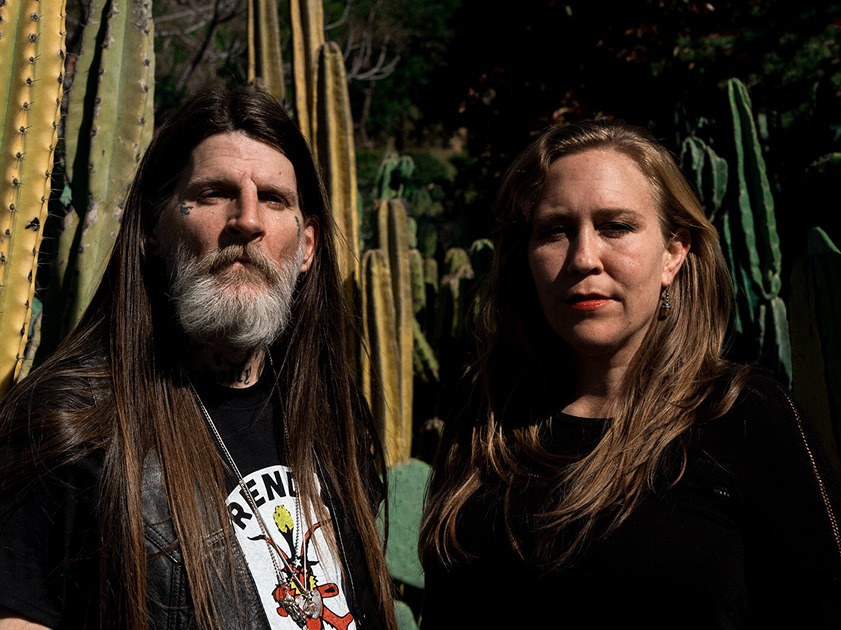
In June 2022, Earth played Le Botanique in Brussels, a venue set in an old botanical garden. Wolfsbane was in bloom. It felt like the perfect setting for their last album, Full Upon Her Burning Lips, with its organic 70s vibe and allusions to poisonous plants. In keeping with the theme, a couple of days later, Dylan Carlson, the founder and guitar player of the band, gave a solo show in a sculpture garden in Antwerp. That’s where we had agreed to do an interview.
Earth doesn’t need any introduction: from the cornerstones of drone metal to Carlson’s 90s tribulations and the band’s resurrection in the early 00s, its impact on contemporary music in general and the metal scene in particular has proven deep and lasting. This cult status never distracted Carlson from his path, though: he always remained dedicated to minimalism and slowness, to the riff. Drummer Adrienne Davies joined in—yes, they did play Earth songs too that evening—and we talked about the latest developments of the band and its history. During the conversation, the two partners in crime chat, joke, contradict each other, finish each other’s sentences: they don’t just describe, they embody the flow of Earth’s music.
This interview took place in June 2022 and was first published on Radio Metal.
It’s the end of your tour in Europe. How did it go?
Dylan Carlson (guitar, bass): Yeah, it went really well. It was funny—I thought we played really well in Brussels, Utrecht was good too. And then at Hellfest of course, because it was being live-streamed on Arte, we had some technical difficulties [chuckles], but we pulled it off.
Adrienne Davies (drums): Every technical thing that could go wrong went wrong in one hour [laughs]. But we played through it, it was great.
Dylan: We played there in 2016 I think—I can’t remember. It’s a lot bigger than it was, they didn’t have all that Thunderdome stuff back then. I find the European festivals are always really well run, things go well.
Adrienne: It’s a lot less of a headache than the U.S. festivals generally.
Is this your first post-Covid tour? And if so, how was it to be back?
Dylan: This is our first time. We did a couple shows in L.A. but they were just one-offs, and I did one solo show in L.A. at Long Beach. But we were pretty much not doing anything
Adrienne: It’s the first time back on the road, dealing with airports and small vans. It seemed a lot harder than it used to be! [laughs]
Dylan: [laughs] We were out of practice.
How was it for you as musicians this two-year break that you were forced to take?
Dylan: Awful, just awful. Nothing going on.
Adrienne: It was kind of a bummer because Dylan moved to L.A. from Seattle right as Covid hit—I was thinking if he hadn’t moved, we could have like written 10 albums! [laughs] We would’ve had so much time to play music. But yeah, it was a long break.
Dylan, this evening you’ll play your solo stuff and a few Earth things as well. How different is it for you to write and play on your own compared to with a band?
Dylan: On my own, I guess it’s just a little looser because it doesn’t have to make sense to the other musicians. I can wander around.
Adrienne: You can get some strange rhythms, yeah! [laughs] But it has a good flow.
Dylan: I like doing the solo stuff too, but the band stuff I like best just because it’s more fun to play with people.
Is that why you tend to work with other people as well, like the Bug or Emma Ruth Rundle, for instance?
Dylan: Yeah. Even for my solo things, I’ve usually had other musicians working with me. When I work with people, it’s because I like what they do: so they do what they do, I do what I do, and it works! I’m not directing people. Emma Ruth Rundle is an amazing musician, so she just came in, did her thing, and that worked. I think it was the same with Kevin [the Bug]. His stuff is a little more constructed, but then how we’d work is that he’d bring something, I’d play to it, and then he’d take it away and alter it based on what I played. Usually, the people I play with, I like how they play. I have enough trouble with just playing my stuff, I don’t wanna have to worry about anyone else’s!
Adrienne: I think that we don’t realize how lucky it is that we’ve been playing together twenty years now, which means that it’s almost like unspoken communication, like we really understand each other musically. We don’t have to explain stuff as much. I’m now noticing how special that is: you can play with other people and it can be good, it can be bad, it can be hard, it can be easy, but it’s unique to be able to have that connection of understanding, almost like telepathy. I didn’t realize how unique it is, it’s pretty cool.
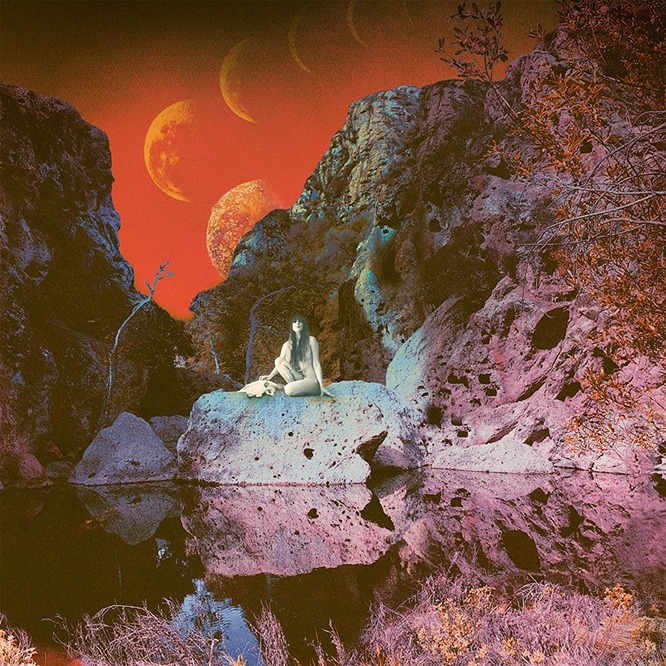
Actually, after Primitive & Deadly, which was sort of open and lush with guest vocalists and so on, Full Upon Her Burning Lips feels like you’re going back to the basics, to a tighter formula with just the two of you. Was it deliberate?
Dylan: Kinda. It’s just how it worked out for that record.
Adrienne: I remember that we did kind of want to keep it insular and not have a bunch of guest musicians. We decided to do that, that was on purpose. The only two human beings on it are Dylan and me, plus Mell [Dettmer] since she was mixing, editing, and recording. It was just the three of us. It kept it really focused, it’s a unique album because of that, I think.
Dylan: I don’t like to make the same album twice. At any opportunity to record, it’s like, “Oh, let’s try it this way.” There’s no formula.
Adrienne: And if there was, you wouldn’t wanna repeat it.
Dylan: No! I don’t understand that.
You’re now on Sergeant House…
Dylan: Well, we’re not technically on Sergeant House the label, but were managed by them. There are separate contracts for every album; I figured, let’s keep it open, not like with Southern Lord where we had three-records deals. I prefer to just do it one at a time.
Adrienne: Especially with how many unknowns there are in the world now, how up in the air everything is.
Dylan: Hopefully, we’ll be doing another one soon for somebody.
Yeah, you played one or two new songs in Brussels…
Adrienne: Yeah, we played two new ones, we’ve been writing stuff and thinking about the next album.
Dylan: Well, I haven’t written a lot. I didn’t do a whole lot during 2020. I wrote one at the start of last year…
Adrienne: But we started writing again while getting ready for all this.
Apparently, you wrote one of the songs at Hellfest a bunch of years ago, and another one was born during a special performance that took place in Ghent where you played a soundtrack to Belladonna of Sadness. How did you approach that, especially since Belladonna of Sadness already had this typical 70s psychedelic soundtrack that’s quite integral to the movie?
Adrienne: Yeah, that was pretty unique, we really should have recorded and filmed this one performance, but we didn’t. It was one of our best shows, really, it was really good.
Dylan: Basically, we watched the movie and played a live film score to every second of it. We had visual cues, and then we’d play according to that.
Adrienne: It was all charted.
Dylan: I don’t know if it was really charted, but we faced the film and followed the visual cues.
What did you reuse for this album? “Descending Belladonna” I assume?
Dylan: “Descending Belladonna” was there…
Adrienne: And then the one whose working title was “The Wedding Song”… “The Mandrake’s Hymn” is what it’s called now.
Dylan: There was another one… Was it “Datura’s Crimson Veils”? I don’t think so. I’m forgetting my own titles…
Adrienne: No, it was “She Rides an Air of Malevolence.” Those are the three.

Three song titles mention plants deemed magical: datura, belladonna, and mandrake. Why this choice? Do you choose a concept and then build the music around it?
Dylan: It depends. When I started, it was more conceptual. I’d have the concept and then write this up. For the last album, the music came first and the concept came later. As for the choice of the concept, I felt like Primitive and Deadly was kind of…
Adrienne: A macho record, very swaggery.
Dylan: So this one has a lot more of this feminine, witchy vibe.
Adrienne: For this last one, I think you did about half the titles and I did the other half, but cohesively, from one voice. Usually, I just get one or two titles but for this one, we split it evenly.
Dylan: It was more collaborative.
What about the title of the album, actually, which sounds quite mysterious?
Dylan: I got that from…
Adrienne: That was mine! It was from one of my Johannes Cabal books, I think.
Dylan: No, it was from…
Adrienne: [laughs] Dyl, I promise you, I came up with that one. It was in one of the books I was reading.
Dylan: I usually find ideas for titles in films or books. Sometimes, I tweak them. Sometimes I just hear a phrase and think, “What if we did something with it?”
On this album, it’s just the two of you. Did it make some room to try things you didn’t really do before? I noticed chords that aren’t open and tracks that are on the short side for Earth, for instance…
Adrienne: We’ve always used a call-and-response thing, at least in how the drums and the guitar interact, but the last album was very cyclical and call-and-response based, more than any other album, I think. The drums and the guitar are like two voices having a conversation, interchanging in a very free way, which leaves a lot of space. And Dylan played bass, too.
How did you add the third musician?
Dylan: Bill [Herzog] has played with us before. We have a group of people that we play with that we bring in.
Adrienne: I wish Dylan could play guitar and bass at the same time. I really like his bass playing, it’s weird—not normal bass playing at all, but I like it.
Dylan: We’ve known Bill for at least twelve years, probably. We played with him, did shows with the bands he used to be in. And then we’re doing a U.S. tour in the fall with that Danish band Iceage, and Brett Netson is gonna join us again for that. He did one of Earth’s U.S. tours and he used to play in Caustic Resin and Built To Spill.
Adrienne: Not everybody can leave for a month, you know: Bill can’t go for more than two weeks. Other people are better at long tours.
Dylan: But it’s fun to change lineups once in a while for tours, mix it up…
What room for improvisation is there when you play live?
Dylan: Some songs have a set form, some don’t, and then in some, there’s a spot for it that we leave open. It’s varying levels, but usually, there isn’t a set plan for everything and it’s more about winging it.
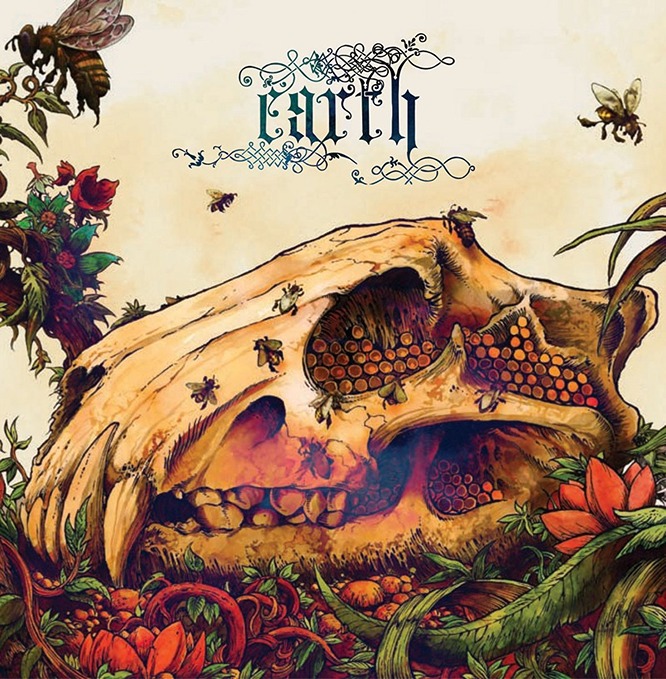
Adrienne: In a song like “The Bees Made Honey In The Lion’s Skull” that we played hundreds if not a thousand times live, we have an area where we can make it different every night. That keeps it fun to play instead of just monotonous [laughs].
Dylan: Some parts are the same, but then some parts are just like, “Okay, how’s the night going?” And we’ll just keep it going. Most of the songs have spots for this.
Adrienne: That’s what’s cool about Dylan’s solo stuff too, because he can pretty much be in pure improv. You have some structure to it, but you can improvise even more, and you don’t have to worry about anyone else catching up.
Dylan: Yeah, I just wing it.
Adrienne: We don’t quite do that with Earth, we’re a little more constructed than that.
I don’t know if you see it like that, but it looks like there are two eras for Earth: the nineties and after.
Dylan: Definitely.
Adrienne, you joined for the second era.
Adrienne: Yep! The cleaner, prettier one.
How has your playing and approach to the music changed throughout the years, especially during such a long collaboration?
Dylan: I had a four-year break for various reasons. I didn’t even own a guitar during that time, I wasn’t playing music. And then I just got a guitar again—in 2001, I think it was. I wasn’t planning on doing Earth again, I just wanted to play again. I just woodsheded a lot that first year, I practiced a lot and got back into it.
Adrienne: We didn’t have any plan about doing Earth.
Dylan: Hopefully, your playing is always improving. I should still woodshed more than I do, but anyway—it was just different. Obviously, I can’t help but play what I do because it’s me: I’m me. I’m not gonna play like anybody else, but I think my musicality and my playing level improved. When I first came back, I was really obsessed with different kinds of gear and all this, but the gear is not what it’s about either. You sound like you. People I used to know who were super into Hendrix bought all the gear and so on: still, they’re never gonna be Hendrix. It seems like all the guitar players I admire, you know who they are: it’s not about their gear. It’s just about them. The goal is just, whatever instrument it is that you play, to let music come out.
Adrienne: To have your own voice on it without sounding just like your idols.
What about you, Adrienne? What kind of music were you playing before Earth?
Adrienne: Mostly short-term punk rock bands in Olympia [laughs], nothing major, no long-standing bands or anything. I just played with a lot of different people, mostly punk rock.
So very fast music?
Adrienne: Still, it was me [laughs], so I’d say it was upper mid-range fast, but definitely not fast-fast. Weird, noisy, arty, kind of loud, low-end-y stuff.
How was it to slow down so much then?
Adrienne: I had to learn that. I had to create my own technique to be able to do it at first: a lot less right angles, a lot more cyclical, so you’re creating a physical drag between the notes as you’re occupying the drum set, like your body is doing the work of slowing it down. And also a lot of—not quite meditation, just breathing, getting your heart rate down helped a lot I found… But yeah, it was a totally different ball of wax compared to any other rock band I’d played in because it was very slow. We’re not as slow now—still slow compared to most bands, but there was a time there when it was very slow, almost past the point where it just stops.
Dylan: We reach mid-tempo now!
Adrienne: [laughs] Yeah, we can actually hit mid-tempo and keep it now.
Dylan, you just mentioned that you feel like you are the instrument and that the music flows through you…
Dylan: On a good night, yeah [laughs].
Adrienne: On a good night, there’s nothing stopping the flow!
Does the environment impact this? Either when you play live or when you write?
Dylan: I feel like everything around you goes into it somehow, but then there’s also the mental landscapes that you decide to inhabit that can influence you. I’m really into reading about history and stuff like that, so I often get into rabbit holes and I feel like it influences certain things. Live, the main thing to me is about just getting out of your way.
Adrienne: Yeah, being in the moment completely.
Dylan: When a show goes really well in my opinion, it’s almost like I start and then it’s over and I’m not sure what happened in between because I’m just in a flow. But when it doesn’t go like that, it can feel like work.
Adrienne: But when it’s working, it’s like being a time-traveler, almost.
Dylan: The thing about music that I find so interesting is that ultimately, what I think about it, what I think the show is like doesn’t matter, it’s what the audience thinks that does. It’s the audience that picks your best show, your best song… What you think as the artist is ultimately irrelevant, which I’m fine with. I’m totally happy with it. The thing I love about live music is that you and the audience are a part of this whole thing, and it’s not gonna happen again. Every show is a different situation, a different group of people, a different spot, and that’s where the magic happens.
In the audience, you get this impression of flow, too. On Wednesday [in Brussels], the crowd was very stiff and serious at first but by the end of the show, everybody was moving. I overheard someone saying: “The slower it was, the more I wanted to dance!”
Dylan: That’s the thing: to me, dance and music are really integral to one another. But I feel like now people have this weird conception that dance music is only like: [hums a beat]… I think it’s weird. I don’t want to go off on a big tangent about how evil civilization is or anything, but I feel like this fracturing of everything—there’s dance, and then there’s music, and then there’s dance music—is weird. It’s just the oldest things that people do, it’s been around forever.
Adrienne: We always try to write songs with very simple, hummable parts, like a kid could hum you the melody back, almost like a lullaby. And when kids dance, when they just kind of rock, you know you’re in the perfect zone. When you can just sway to it, you know? At least it’s what I aim for.
Dylan: And it’s the thing with repetitiveness: it’s gotta be something you want to hear again. And if the riff’s not good, then don’t repeat it! [laughs] And move on.
You often say that you found your one concept very early on, in your early twenties: this idea of repetition, of minimalist music. You’re still working within the same paradigm, but did your take on it change through the last three decades?
Dylan: I don’t know. I did figure it out in 1989, I think. The ultimate goal is that I still want to make it musical. I feel like a lot of bands focus on one thing and then forget about the rest, but it still needs to be musical. It still needs to be engaging. I feel like I’m constantly refining the listenability of my music. I want it to connect. This is gonna sound arrogant, but I feel like a lot of bands that name-check us got the wrong lessons from us—or from me. I want everyone to do whatever the fuck they want to do and be happy doing it—if they’re happy doing that and people love it, cool—but sometimes I think, “You didn’t quite catch what I wanted to say.”
Adrienne: Or they didn’t scratch past the surface of what you’re trying to do.
Dylan: I don’t wanna sound like an old guy, but I feel like a lot of new music is all about being a caricature or shtick that people can just grab…
Adrienne: Having a perfect image and being describable in one word…
Dylan: And then there’s all these subgenres… When I’m asked what I play, I answer, “I play rock’n’roll.” I play slow rock’n’roll, I don’t think it’s a bad term. Some people may think it’s a grandpa term, but whatever. The other day, we were listening to my music in the van—I listen to what’s called classic rock now, a lot of rock’n’roll, country, blues…—and it was funny because people were like: “I don’t understand, you listen to that music: how do you come up with yours?” I don’t just sit in a cave and listen to doom rock or drone metal, you know? I love all kinds of music and all kinds of music inspire me, I hear stuff in all the music that I like that I can apply to what I do. Once, I was told I play really bluesy, and I think that yeah, I do. I love American music, blues, country, jazz, and rock’n’roll, and I consider myself part of that continuum… Anyway. I’m getting ranty.
Adrienne: Since we just played at Hellfest, what I noticed is that metal fans might look the part but they have some of the broadest taste. Some big metalheads are super well-versed in jazz for instance, and other things, not just metal. It’s always cool to have as many influence as possible and not just listen to one thing.
What is interesting about drone is that it can either get really intellectual and abstract or really visceral, which is more accessible. I’m not sure everybody would agree but to me, Earth’s music is easy to listen to, cozy almost…
Dylan: I hope so! [laughs] I just try and do the music that I want to do and then hope people like it. When they do, I’m so grateful. I’m grateful for everyone who’s come to a show, bought a record or a T-shirt, that supported me in any way… That’s why I always make time to go out to the merch table and talk to people. I’m not one of those guys that hide… I see bands who treat their fans like shit and I’m like, “Dude, you guys would be broke if it weren’t for them.” I know I’d probably be in fucking jail or something like that if it weren’t for rock’n’roll! Everyone has a bad day, you get tired, but it doesn’t take anything to be polite and nice to people.
You were saying that you feel like an American musician in the continuity of folk and country: it’s really obvious in your last solo album, Conquistador, or in Earth’s Hex; or Printing in the Infernal Method. Before that, English influences were noticeable as well…
Dylan: I love the U.K., a lot of my ancestors came from Scotland, England, Ulster… It’s one of the building blocks of American music. What I love about American music too is that it’s all from the bottom up. There’s no high culture, it’s all poor white people, poor black people, poor Indians… The music is not from fancy people.
Adrienne: The working man and woman’s strife, the sweat.
Dylan: That’s what I mean. It doesn’t come from a place of privilege, state sponsorship, or art money.
Rock’n’roll used to be working-class music, but it’s not really the case anymore…
Dylan: That’s what I’m saying, it’s all like rich kids now. Daddy pays for the first album, and the instruments have gotten so expensive… Like my friend Mark Lanegan said, “There are two kinds of people that do music: the ones that do it for what they can get out of it and the ones who do it because they have to.” The great music is made by the people that have to do it for whatever reason. Whereas the crap music is made by people for whom it’s just a project they do before working in their dad’s accounting firm or whatever—I don’t know what the fuck they do afterward but they don’t stick to it. They’re just trying to get paid. But the thing is that you have to love it no matter how much you make at it. People always act like being in a rock band is like parting all the time or a permanent vacation. No, it’s not. Even making good money, it’s sitting in a van ten hours a day and waiting at airports. I don’t mean to complain too much about it because it beats coal mining or digging graves—a lot of my ancestors dug coal, actually. It’s certainly not that. But the rich kids who want to party, they go away, they won’t last. All these influencers who suddenly have a music career—no they don’t! They won’t last thirty years. You have to love it and then maybe you become good at it [laughs].
Many thanks to Dylan and Adrienne for their spontaneity and generosity.
More about Earth here and there. In the meantime, the band released a new album, Even Hell has its Heroes, composed for a film of the same name retracing the story of Earth. It’s not too late to catch a screening—see here.
 Chaosphonia
Pingback: Herbes du diable II | Consanguines
Pingback: Saturnalia Temple | Lighting up the Path | Chaosphonia